
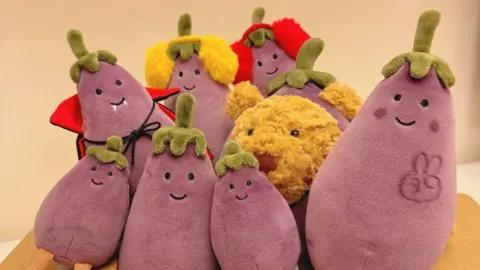
A woman named Stella purchased her initial Jellycat brand plush toy in the midst of a time of unemployment during the global health crisis. Encouraged by an acquaintance's passion for these UK-created toys, her interest was truly sparked when she saw an adorable gingerbread cottage design circulating on a widely-used Chinese social media platform.
While Christmas isn't traditionally observed in China, being more of a commercial event than a religious festival, the concept of gingerbread houses appealed to Stella. "The festival doesn't mean much for me... However, I have always loved the appearance of gingerbread houses," she explains. This led her to request an old friend from her hometown to purchase the item on her behalf.
That acquisition took place in 2021, right as the brand was poised of achieving significant success in China and internationally. "People were uneasy, and nobody knew what would happen," recalls Stella, who developed a habit of petting and hugging her plushies to cope throughout a difficult period. Living in Beijing, which experienced some of the most stringent restrictions in the world, she passed a great deal of time indoors.
Now 32 and working in tourism sector in the tourism industry, Stella continues to grow her assortment. Her collection has swelled to around 120 items, representing an investment of about 36,000 yuan. "As an adult, you have many things you can't discuss with other people... and the problems we face are far more complex than before," she notes reflectively. "The plushies help me managing my emotions."
Originally created with kids in mind, these soft toys have evolved into an international sensation, especially in China where a increasingly disenchanted younger generation has been seeking solace in them for comfort and solace.
The Rise of Kidults
Her gingerbread cottage plushie belongs to the "Amuseables" collection, a set of toys with tiny expressions inspired by everyday inanimate objects, from bathroom tissue to hard-boiled eggs. These plushies are considered the "standout success" that "resonate with a wide Gen-Z and millennial audience" globally, as noted by industry analysts.
Their growing popularity "could have something to do with a desire to feel a sense of connection," propose cultural commentators. It is hard to say for sure if the introduction of the iconic Amuseable line in 2018 was a deliberate strategy to engage the young adult consumer, toy manufacturers are under pressure to must cultivate new markets due to falling birth rates across numerous countries.
The brand entered the Chinese market as early as 2015. By laying significant "groundwork", the company was well-positioned to capture "the tone of the pandemic"—when people sought comfort amid widespread uncertainty—and built on its early success in the country, according to business consultants.
Jellycat's fame was further boosted by engaging temporary events. These retail events sometimes offered a selection of exclusive "culinary" products. Numerous enthusiasts record themselves being served and post the clips online.
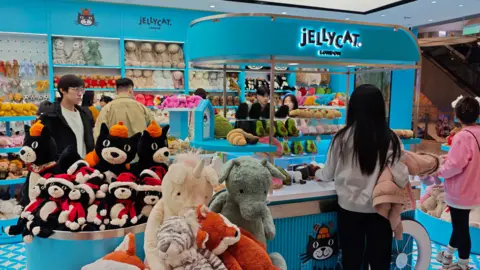
Adaptation to local tastes has also been an essential strategy. As an example, fans were able to buy plush versions of classic UK dishes like fish, chips and mushy peas during a temporary shop in London. Meanwhile, products including teapot and teacup plushies were sold at exclusive outlets in Beijing and Shanghai last year.
Last year, the British firm's revenue reportedly rose significantly to reach a substantial figure. In the same timeframe, it sold an estimated $117 million worth of toys in China via leading online marketplaces, according to market intelligence estimates.
This growth mirrors a wider surge in China's collectible toy market among young adults seeking emotional comfort and connection. Total revenue from collectible toys in China are expected to exceed 110 billion yuan annually, according to a recent analysis.
The remarkable success of other toys such as Labubu, elf-like dolls from domestic company Pop Mart, underscores the market's increasing appetite for designer collectibles. The so-called "adult-child" phenomenon isn't exclusive to China; adults worldwide are starting to question "traditional understandings of what it means to be an adult," note academics.
Particularly, especially the aubergine character—affectionately dubbed "the boss" by Chinese fans—have spawned numerous memes, with many sharing grievances regarding adult life. The "aubergine boss" tag serves as a platform where people sketch various emotive faces on the plushie, depicting it in different states enjoying a drink to fake-smiling.
As an illustration, a marketing professional from Hong Kong, Wendy Hui, modified her aubergine Amuseable by drawing bags under its eyes and placing a pair of glasses on the toy. She then shared a picture online with the caption: "The mood of employees at the start of the week." "I was working at home even on time off," the 30-something says. "I just wanted to express how exhausted I was."
Thus, Jellycat has become a surprising, whimsical outlet for China's youth to air their frustrations about economic challenges, where hard work no longer ensure comparable rewards. Despite heavy content regulation, digital spaces have become a crucial, perhaps the primary, arena for these types of discussions.
The brand's regular releases of exclusive designs and the retirement of certain lines—a strategy sometimes referred to as "scarcity marketing" locally—has also driven {

